 With Tisha b’Av in our rearview mirror, the next significant Jewish calendrical date is that of Tu b’Av, the 15th of Av, which is today. The first text we have on this date is as follows (mTa’anit 4:8):
אָמַר רַבָּן שִׁמְעוֹן בֶּן גַּמְלִיאֵל, לֹא הָיוּ יָמִים טוֹבִים לְיִשְׂרָאֵל כַּחֲמִשָּׁה עָשָׂר בְּאָב וּכְיוֹם הַכִּפּוּרִים, שֶׁבָּהֶן בְּנוֹת יְרוּשָׁלַיִם יוֹצְאוֹת בִּכְלֵי לָבָן שְׁאוּלִין, שֶׁלֹּא לְבַיֵּשׁ אֶת מִי שֶׁאֵין לוֹ. כָּל הַכֵּלִים טְעוּנִין טְבִילָה. וּבְנוֹת יְרוּשָׁלַיִם יוֹצְאוֹת וְחוֹלוֹת בַּכְּרָמִים
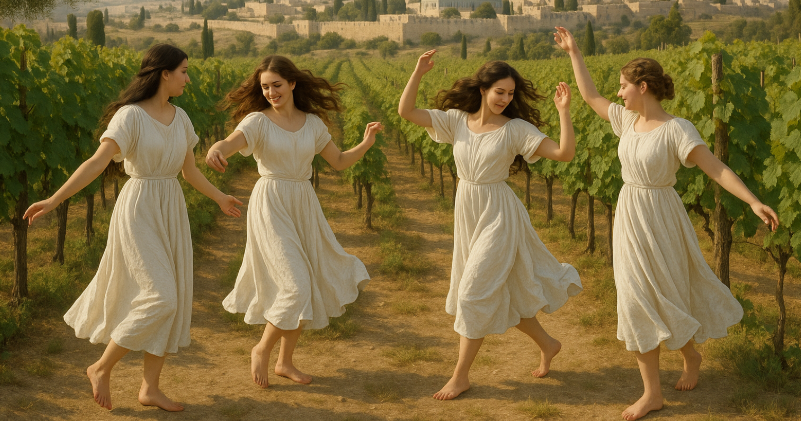
Rabban Shimon, son of Gamaliel (2nd century CE), said: “There were no days as joyous for the Jewish people as the fifteenth of Av and as Yom Kippur, as on them the daughters of Jerusalem would go out in borrowed white clothes, so as not to embarrass one who did not have such garments, all of which required immersion. And the daughters of Jerusalem would go out and dance in the vineyards…” .
As we seldom encounter texts in the Mishnah concerning mating/paring/dating practices, this description certainly stands out. Surely, one aspect that is apparent is the wistful view of Rabban Shimon, son of Gamaliel, who shares that this took place long ago, prior to the destruction of the Temple, prior to the sad destruction of the Temple, thus serving as a fitting literary juxtaposition to the previous descriptions concerning Tisha b’Av before it in the Mishnah (mTa’anit 4:6-7), which further underscores how Jewish life was happier pre-destruction.
Questions
The Mishnah’s description raises an obvious question: why were these dances held specifically on Yom Kippur and Tu b’Av? These two occasions seem to have almost nothing in common. Yom Kippur is defined by fasting, abstention from physical pleasures, and the prohibition of labor, while Tu b’Av carries none of these restrictions. Third century sages were similarly puzzled. While they readily understood the significance of Yom Kippur, they offered a half-dozen explanations for why the fifteenth of Av should also be celebrated in this way (Bava Batra 120b-121a & Ta’anit 30b-31).
Yet perhaps these sages were searching for two independent explanations when the Mishnah itself may hint at a single connection. Rather than viewing these as unrelated holidays that coincidentally shared the same custom, perhaps the two dates marked opposite ends of a single seasonal cycle. As discussed on episode 71 of The Jewish Drinking Show, “The Wine Festival in the Dead Sea Scrolls”, late summer and early fall constituted the grape harvest season in Second Temple Israel, as they still do today. It is therefore possible that, despite the otherwise opposite character of these two days, Tu b’Av and Yom Kippur were temporally located near the opening and closing celebrations of the grape harvest.
Seen in this light, the Jerusalem courtship dances become more than social gatherings. They become ceremonies that both inaugurated and concluded the vineyard season. Such a connection naturally raises another question: what relationship exists between vineyards, wine, and love?
Why Only the Daughters of Jerusalem?
As to why it was only the daughters of Jerusalem, it may have been that they had a critical mass, bigger than any other town or village throughout Israel pre-destruction of the Temple. One wonders if non-Jerusalemite single Jewesses came to take part in this activity and the description stuck, since most of those dancing were from Jerusalem? Another possibility may have been that other cities were smaller, but Jerusalem was so populous that it may have been harder to more easily connect with other people in such a huge city. Another consideration is that they may have been culturally different so as to want to be able to engage in such massive events.
Why Vineyards?
If the dances were indeed tied to the grape harvest, another question naturally follows: why were they held in vineyards at all? The location is striking because it is unique within the Mishnah, since public gatherings are normally described as taking place in courtyards, marketplaces, or other communal spaces within cities (e.g. Ta’anit 2:1, Bikurim 3:2, & Megillah 3:1). While vineyards are not presented elsewhere in the Mishnah as places for communal celebration, we do, however, read of a biblical precedent of vineyards as the site of men taking young women. While an entirely different social dynamic, especially considering consent, we do read of a biblical precedent where men take “the daughters of Shiloh” (similar language to “daughters of Jerusalem”) as they are emerging from the vineyards (Judges 21:19–23). One wonders how often young, single Jewesses were in vineyards in the Jerusalem area in the times of the Second Temple.
One distinct advantage of the vineyard is privacy. Dancing outside the city walls created a space set apart from married men and older community members. This provided a secluded environment where young women could dance freely, away from critical eyes, while offering eligible young men an exclusive opportunity to meet prospective spouses.
The location, however, also presented practical challenges. Vineyards are planted in rows that obstruct visibility. How, then, did the women dance? Did they move between the rows? Did they dance along the perimeter of the vineyards? Were open spaces intentionally left for the performances? The Mishnah offers no details, leaving us only to imagine how the physical layout of the vineyards shaped the event.
When Did the Dancing Occur?
The Mishnah leaves unanswered the question of when these dances took place on these two dates: Did they occupy the entire day, or only a particular portion of it? Were they held in the morning, the afternoon, or toward evening?
The question becomes especially intriguing on Yom Kippur. If the dances occurred late in the afternoon, they would have demonstrated remarkable youthful energy despite a day spent fasting. Both the women dancing and the young men walking from Jerusalem to the vineyards would have done so near the conclusion of one of Judaism’s most physically demanding days.
Nighttime presents another possibility. Evening temperatures would certainly have been more comfortable during the heat of late summer. Yet darkness would also have made it much more difficult for the young men to observe the dancers, even if torches illuminated portions of the vineyards. Combined with the rows of grapevines that already limited visibility, nighttime dancing would have posed obvious practical difficulties. The Vineyard as a Seasonal Gathering Place
Another possibility has less to do with symbolism than with the rhythms of agricultural life. Today, many young adults spend summers working in seasonal jobs, such as camps, where they live together for 2-3 months, develop friendships, and create social opportunities beyond their work. Perhaps vineyards functioned similarly during the grape harvest.
Harvesting grapes requires many hands, and vineyards likely needed temporary labor during this busy season. It is conceivable that vineyard owners hired unmarried young people from Jerusalem to assist with the harvest. If these young workers spent weeks together in the vineyards, they would have become familiar not only with the work itself, but also with the landscape. The vineyards could, therefore, have become natural gathering places for recreation and courtship in much the same way that seasonal workplaces often become social communities today.
Within this framework, Tu b’Av may have celebrated the beginning of the harvest season and the formation of these temporary communities, while Yom Kippur marked their conclusion just before the joyous celebrations of Sukkot.
Was There Drinking?
Finally, a question especially relevant to readers of this publication concerns the possibility of drinking: did these vineyard celebrations involve wine?
The Mishnah is silent, but the setting invites the question. On Tu b’Av, it is conceivable that participants drank wine, perhaps newly fermenting or partially fermented wine, from the earliest grapes already harvested. Such drinking would have complemented both the vineyard setting and the joyful atmosphere of courtship.
Yom Kippur, however, presents the obvious difficulty that drinking would have been prohibited throughout the day. One possible solution is chronological. If the dances occurred late in the afternoon and continued until nightfall, perhaps the celebration continued after the fast ended, when participants could finally eat and drink together. This remains speculative, but it once again highlights how closely the unanswered question of drinking depends upon the unanswered question of timing.
Whether or not wine was actually consumed, the symbolism remains compelling. The dances took place not merely in agricultural fields but in the very place where the grapes destined to become Israel’s most celebrated beverage were grown. Even if no wine was yet poured, the vineyards themselves formed the natural setting for a celebration that intertwined love, harvest, and the promise of wine.
Conclusion
Whether or not wine was actually drunk on these occasions, the vineyards themselves provide a powerful metaphor. A vineyard is a place where something small and full of promise gradually matures into something far greater. Grapes become wine through time, care, and cultivation; so too, youthful attraction has the potential to mature into enduring love, marriage, and the establishment of families. Holding these dances among the vines therefore symbolically situated the search for one’s spouse in the very place where another of Judaism’s greatest sources of joy begins its own journey toward fulfillment. As the Song of Songs famously intertwines love and wine (Song of Songs 1:2), the choice of venue may have embodied that very relationship. As we look forward to Tu b’Av, may we all enjoy this festive day, wine, and, of course, love.